
Right now, a lot of us are trying to figure out how to keep showing up without disappearing into the work.
Black people are tired.
Black women are tired.
Black femmes are tired.
Black trans people are tired.
Queer people, poor people, disabled people, organizers, caregivers, advocates, artists, teachers, healers, and the people who keep being asked to hold everything together are tired.
And not tired in a cute way.
Not tired in a “take a bubble bath and come back tomorrow” way.
Tired in the body.
Tired in the nervous system.
Tired in the spirit.
Tired from watching the same conversations return with new hashtags.
Tired from being expected to explain our humanity to people who have already decided how much of it they are willing to recognize.
Tired from carrying family, community, work, grief, fear, anger, hope, memory, and responsibility all at the same time.
And still, the question keeps coming:
What are we supposed to do?
How are we supposed to show up?
How much grace are we supposed to extend?
How much harm are we supposed to absorb?
How much of ourselves are we expected to sacrifice to prove that we love our people?
That is where this companion kit begins.
Not with a demand.
Not with a performance of strength.
Not with another checklist for becoming more useful.
This kit begins with permission.
Permission to be human before being heroic.
Because many of us were raised to believe that loving our community meant carrying our community.
We learned to be the strong friend.
The reliable one.
The advocate.
The protector.
The person who always shows up.
The person who absorbs conflict.
The person who extends grace.
The person who makes room for everyone else’s humanity, even when nobody has made room for ours.
And there is beauty in showing up for our people.
There is power in care.
There is sacredness in community.
There is something deeply ancestral about refusing to let each other disappear.
But there is also danger when care becomes a requirement for self-abandonment.
There is danger when grace becomes another word for silence.
There is danger when community asks us to give everything, then calls us selfish when we admit we are empty.
There is danger when the people most impacted by harm are also expected to be the most generous in explaining, forgiving, enduring, and repairing it.
That is not liberation.
That is depletion wearing the language of love.
The Grace Quotient is not about measuring how forgiving you are.
It is not about proving that you are compassionate enough.
It is not about deciding whether somebody else deserves grace.
It is about understanding your capacity.
It is about honoring your humanity.
It is about asking a question that many of us were never given permission to ask:
What can I actually carry right now?
Not what do I care about.
Not what am I angry about.
Not what do I wish I had energy for.
Not what would people respect me for doing.
What can I actually carry right now?
There is a difference between what matters to us and what we can hold.
That distinction can save us.
You can care deeply about your people and still need rest.
You can believe in justice and still have boundaries.
You can want liberation and still be overwhelmed.
You can love your community and still refuse to be consumed by it.
You can be committed without being constantly available.
You can be accountable without being endlessly accessible.
You can extend grace without tolerating harm.
For Discovering Your Power, grace is not measured by how much harm you can survive.
Grace is measured by your ability to remain connected to your values while honoring your humanity.
That is the real work.
Not endless patience.
Not unlimited access.
Not spiritual bypassing.
Not pretending things do not hurt.
The work is discernment.
The work is capacity.
The work is sustainable participation.
The work is asking:
What is mine to carry?
What is mine to witness?
What is mine to support?
What is mine to release?
What requires my action?
What requires my boundary?
What requires my grief?
What requires my silence?
What requires my refusal?
That kind of reflection matters because we are not just living through personal stress.
We are living through overlapping crises.
Political crisis.
Economic crisis.
Spiritual crisis.
Community crisis.
Relational crisis.
Crisis around gender.
Crisis around safety.
Crisis around truth.
Crisis around whose humanity is considered negotiable.
And in the middle of all of that, marginalized people are often asked to be endlessly resilient.
We are asked to explain.
To organize.
To forgive.
To educate.
To mobilize.
To make room.
To stay hopeful.
To remain loving.
To keep fighting.
To keep showing up.
But we are not limitless people.
That sentence feels simple, but many of us have not lived as if it is true.
We have treated our exhaustion like a moral failure.
We have treated our boundaries like betrayal.
We have treated our needs like inconveniences.
We have treated our pain like something to manage quietly so we can get back to being useful.
This laboratory is an interruption of that pattern.
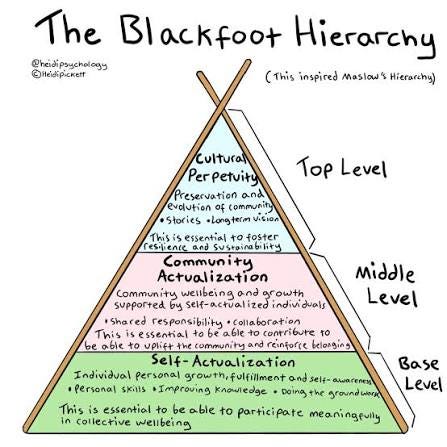
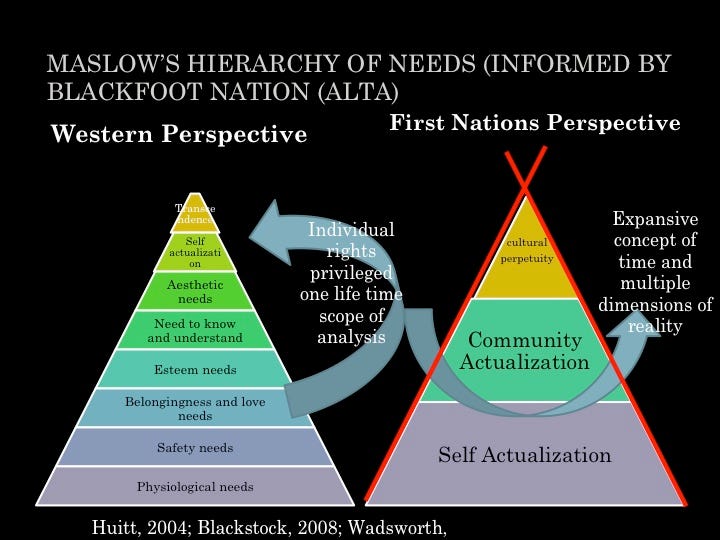
The Grace Quotient asks us to move through three levels of reflection:
Self-Actualization.
Community Actualization.
Cultural Perpetuity.
Before we save the world, we have to know ourselves.
Before we sustain a culture, we have to sustain a community.
Before we sustain a community, we have to sustain ourselves.
That does not mean the self is the only thing that matters.
It means the self is part of the ecosystem.
You are not separate from the community you are trying to protect.
Your body is part of the future you say you are fighting for.
Your health is part of the work.
Your safety is part of the work.
Your joy is part of the work.
Your boundaries are part of the work.
Your ability to remain here without becoming hardened, hollowed out, or consumed is part of the work.
Cultural perpetuity asks us to think beyond this moment.
Beyond this news cycle.
Beyond this fight.
Beyond the urgency that convinces us everything must be handled right now by us alone.
It asks:
What do we want future Black women, femmes, queer people, trans people, and children to inherit?
What values do we hope survive long after we are gone?
What do we want them to know about care?
About accountability?
About safety?
About truth?
About courage?
About repair?
About joy?
About boundaries?
About liberation?
And maybe most importantly:
What do we hope they never have to carry because we chose to build something different?
That question changes the work.
Because if the future matters, then sustainability matters.
If our people matter, then our people cannot only matter when they are producing, organizing, sacrificing, or surviving.
If liberation matters, then we cannot keep building movements, families, communities, and institutions that rely on the quiet destruction of the people holding them together.
This companion kit is designed to help you slow down long enough to tell the truth.
Not the polished truth.
Not the public truth.
Not the truth that makes you seem strong.
The real one.
The truth about what you are carrying.
The truth about where you are afraid.
The truth about where you are angry.
The truth about where your compassion is becoming resentment.
The truth about where your commitment has started to feel like captivity.
The truth about what you need.
The truth about what you can offer.
The truth about what you cannot offer anymore.
Inside the kit, you will find five pieces.
The Micro-Glossary gives you language for the work. Words like grace, capacity, discernment, martyrdom, boundaries, sustainable participation, and cultural perpetuity are not just concepts. They are tools for understanding what is happening inside you and around you.
The Laboratory Worksheet is the heart of this pack. It moves you through reflection and strategy-building using the Discovering Your Power flow. You will check in with your body, name what is weighing on you, examine where you are being asked to show up, reclaim your capacity, reflect through the Blackfoot framework, and build a strategy for the next 30 days.
The Media Immersion Guide offers music, film, and television that explore protection, care, responsibility, exhaustion, community, over-functioning, and the cost of pretending we are limitless.
The Related Reading List brings together fiction and nonfiction that expand the conversation around rest, accountability, self-definition, survival, cultural memory, and collective care.
The Workbook Playlist gives you a soundtrack for reflection. These songs were chosen because they speak to resilience, protection, inspiration, self-care, community care, and the complicated space between showing up and burning out.
Use this pack slowly.
You do not have to complete it all in one sitting.
You do not have to answer every question perfectly.
You do not have to turn this into another assignment.
Let it be a laboratory.
Let it be a mirror.
Let it be a place where you can tell the truth without being punished for having limits.
The goal is not endless grace.
The goal is not endless availability.
The goal is not to become so healed, so spiritual, so committed, or so politically aware that nothing hurts you anymore.
The goal is sustainable participation in the work of liberation.
The goal is to stay connected to your values without abandoning your body.
The goal is to love your people without treating yourself as disposable.
The goal is to build a future where our communities survive, thrive, and continue.
You do not have to save everyone.
You do not have to respond to everything.
You do not have to carry every crisis.
You do not have to prove your commitment through exhaustion.
Your worth is not measured by your depletion.
Your value is not measured by your sacrifice.
Your community needs your humanity more than it needs your martyrdom.
Start there.
Start with the truth.
Start with your capacity.
Start with what remains possible when you stop confusing self-abandonment with love.
Included in this companion kit
DYP Module: The Grace Quotient — Micro-Glossary
DYP Module: The Grace Quotient — Laboratory Worksheet
DYP Module: The Grace Quotient — Media Immersion Guide
DYP Module: The Grace Quotient — Related Reading List
DYP Module: The Grace Quotient — Workbook Playlist

Subscriptions keep this work sustainable. I’m keeping the core law conversation free because access matters. The companion materials live under subscription so I can build with care, rigor, and consistency. Paid subscribers receive the downloadable PDFs. Founding members also receive access to the monthly Discovering Your Power sessions I facilitate.
I see a shift in real time of people either speaking on showing up in community or seeking community. Social media promotes individualism heavy and the masses do follow that principle but a shift is happening and I’m proud to witness it. The work of self and community development is parallel bc it’s unlikely you can give grace to the community if you haven’t given grace to yourself.
Appreciate this!